
In Conversation with Elisa Obermann: Unlocking Canada’s Marine Renewable Energy Future
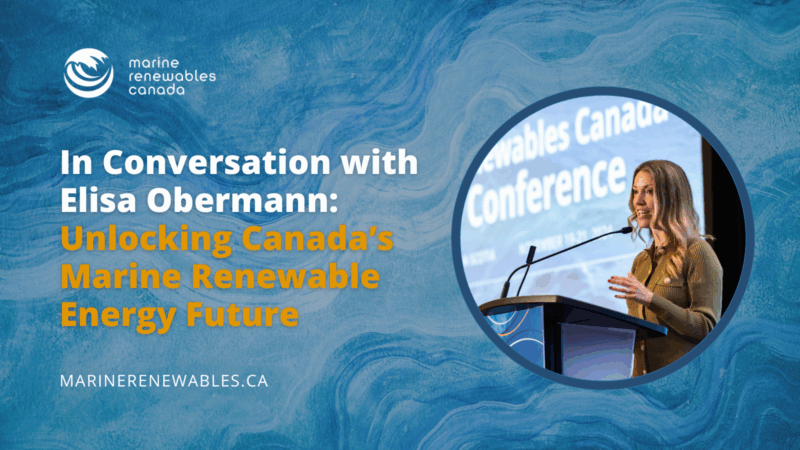
Interview by Anastasia Smolentseva, MComm, Senior Communications Consultant in the Renewable Energy Sector
Anastasia Smolentseva: Elisa, you’ve led Marine Renewables Canada (MRC) for over a decade. How would you describe your vision for the organization as Canada stands on the cusp of major energy transformation?
Elisa Obermann: Our vision is bold yet clear: to establish Canada as a global leader in marine renewable energy – spanning tidal, offshore wind, wave, and river current technologies. This goes beyond deploying turbines or wave devices; it’s about creating a complete ecosystem: robust supply chains, skilled workforces, strong Indigenous and community partnerships, and the infrastructure to sustain it all.
We’re committed to ensuring this industry drives long-term job creation, attracts investment, and accelerates Canada’s emissions reduction goals. In recent years, a series of major milestones has brought us closer to a thriving, world-class industry – one that meets Canada’s growing clean energy demand and powers a more sustainable economy.
Atlantic Canada’s Supply Chain: Opportunity in Motion
Anastasia: A recent study commissioned by MRC highlights major opportunities for Atlantic Canada’s wind energy supply chain. What stood out to you in those findings?
Elisa: The report confirms what we’ve long believed – Atlantic Canada is incredibly well-positioned to lead in offshore wind energy development. During peak construction of new projects, we could see up to 6,000 local jobs.
What’s more, over 60% of assessed companies in Atlantic Canada already have relevant capabilities to participate, from marine logistics to fabrication. That means we’re not starting from scratch – we have a foundation to build on.
The report also emphasized the importance of diversity and inclusion. Sixteen percent of the companies surveyed were Indigenous-owned or otherwise diverse enterprises. That’s a tremendous strength, and we need to scale it by investing in training, infrastructure, and strategic partnerships.
The global offshore wind energy sector is booming, with US $1 trillion expected to flow into this market by 2040. While Canada has some of the best wind resources in the world and over 300,000 km² of ocean under consideration for offshore wind development, we have yet to install our first megawatt.
Of course, there are challenges: ports need upgrades, transmission must be planned, and workforce development is critical. But the opportunity is there – if we act now.
Marine Renewables: A Unique Canadian Proposition
Anastasia: Beyond offshore wind, there have been some major positive developments in tidal, wave, and river current energy across Canada. Tell me more about the current landscape.
Elisa: Canada is making exciting strides in the broader marine renewable energy space. Beyond offshore wind, we’re advancing tidal, wave, and river current technologies that together represent a massive clean energy opportunity.
Tidal power alone offers an estimated 40,000 megawatts of potential, and when you include wave and river current resources, that number jumps to 340 gigawatts – enough to power every home in Canada five times over.
Much of the tidal energy activity has been centered around the Bay of Fundy, Nova Scotia, home to the Fundy Ocean Research Centre for Energy (FORCE). FORCE has already overseen multiple device deployments and continues to support new projects moving toward commercialization.
On the West Coast, British Columbia is well-known for wave energy research led by the University of Victoria’s West Coast Wave Initiative (WCWI), which explores how to harness the significant wave resources off Vancouver Island. With numerous high-potential tidal sites, progress is also being made in developing small-scale project solutions for remote and Indigenous communities in areas like Blind Channel and Haida Gwaii.
One of Canada’s best-kept energy secrets may be river current power – holding potential in every province and gaining momentum through project demonstrations in British Columbia, Manitoba, the Northwest Territories, and Quebec.
While offshore wind opens the door to large-scale opportunities like green hydrogen production, ammonia, and clean electricity exports, tidal, wave, and river current energy technologies hold the potential to deliver innovative, community-based solutions – especially for the 100+ remote and Indigenous communities that continue to rely on diesel and fuel oil.
I’m excited to dive deeper into our sector’s milestones, opportunities, and innovations at MRC’s upcoming annual conference.
#MRC2025: The Place to Be
Anastasia: Let’s talk about your flagship event, the 2025 Marine Renewables Canada Conference & Exhibition, happening this November in Halifax. Why is this event so important?
Elisa: The timing couldn’t be more critical. Nova Scotia is preparing to launch its first offshore wind bid call in the coming months, a major milestone that will set the tone for Canada’s role in the booming global market. At the same time, we’ll be seeing new tidal technology demonstrations in the Bay of Fundy, and learn of the progress made in community-scale marine renewable energy solutions in other parts of the country.
Through dynamic plenaries and in-depth technical sessions, the Conference will explore the sector’s most pressing challenges and opportunities – from harnessing AI solutions and advancing Indigenous participation to unlocking new investment pathways.
Overall, MRC 2025 is expected to bring together over 500 leaders from around the globe – developers, innovators, policymakers, Indigenous partners, and supply chain companies. Our international delegate program, B2B meetings, and networking events are always a key draw, but this year the appetite for engagement is huge. We’ve expanded the exhibition space and moved to a larger venue to keep up with demand. We expect record-breaking attendance and participation, and that tells you everything about the urgency and importance of what’s at stake.
To us, this isn’t just another conference – it’s where opportunities turn into action. If your company wants to play a role in this next energy chapter, this is the place to be.
__
The 2025 Marine Renewables Canada Conference & Exhibition will take place on November 12-14 at the Halifax Convention Center in Halifax, Nova Scotia. Register today, showcase your company or demonstrate your leadership: https://marinerenewablesconference.ca/.